
The
Reveal
Way
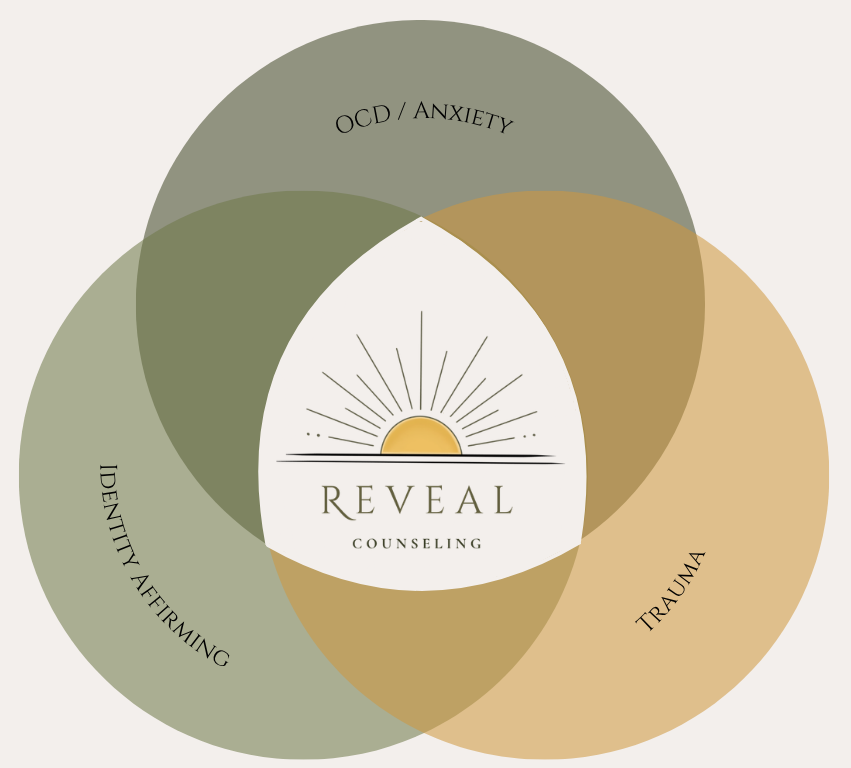
Those who experience symptoms related to OCD/anxiety and trauma often have mental health experiences that are more complex than the sum of its parts, especially if you are also a member of a marginalized identity group.
They may have received therapy in the past that seemed to work really, really well for some symptoms but left out or even worsened others. They may have felt that their experiences were too complicated to understand or begin to tease out, leading them to avoid therapy in the first place.
If this sounds like you, you are not alone in your experience. Thankfully, treatment is possible, and expertise in this particular intersection is what separates Reveal Counseling from other practices.
-
Obsessive-Compulsive Disorder (OCD) is a mental health condition characterized by obsessions (intrusive or unwanted thoughts, feelings, urges, or mental images) and compulsions (mental or physical behaviors done to stop, reduce, or avoid obsessions). Though OCD in the media is often depicted as being related to either germs or needing things to be orderly, OCD can attach to any topic: from worries about whether or not your partner is “the one”, to worries that you are attracted to someone or something inappropriate, to fears that you might be a bad person if you do not complete a particular action.
According to research conducted by the International OCD Foundation, between 81-98% of individuals with OCD are not receiving effective, evidence-based care. Here at Reveal Counseling, we use Exposure and Response Prevention, or ERP, the gold-standard treatment for OCD and one of the most established and effective treatment models.
-
Post-Traumatic Stress Disorder (PTSD) is a mental health condition that is the result of directly experiencing or vicariously witnessing an extremely dangerous, stressful, or potentially violent event. Most have some difficulty adjusting after a traumatic event, but if severe symptoms persist, they might meet criteria for Acute Stress Disorder or PTSD.
Some symptoms of PTSD include having intrusive thoughts or dreams about the event, or having a strong physical reaction when something reminds you of it. You might try to avoid triggers or thinking about it, become more irritable or jumpy, or have difficulty sleeping or concentrating. You might even blame yourself.
These symptoms are your brain’s way of coping with something incredibly distressing, and it is doing its best to prevent it from happening again. This is incredibly common, and you are not alone. Acceptance and Commitment Therapy (ACT) and Cognitive Processing Therapy (CPT) are incredibly effective treatments for trauma-related mental health conditions.
-
There are many different forms of anxiety, from worries about daily life and responsibilities, to health, to social situations, panic disorders, or specific phobias. Anxiety is normal and helpful for every human, and it’s protective. Without anxiety, we wouldn’t look both ways before crossing the street, we wouldn’t bother with emergency funds, we’d walk a little too close to the edge of a cliff.
But when anxiety grows beyond this, when it is no longer helpful and instead interferes with our life, work, or daily functioning, is when it might benefit from receiving treatment. Both Acceptance and Commitment Therapy (ACT) and Exposure and Response Prevention (ERP) are clinically effective for this.
-
The founders of Reveal Counseling are both queer and neurodivergent and strive to offer practices that are affirming to those with these marginalized identities. We recognize that, although the treatment methods we provide are evidence-based in nature, the foundations of medical research have historically left out minority-group populations. We will remain humble while serving our clients and be mindful of feedback on what is and is not helpful, rather than assuming one specific approach to treatment is the key to success.

Ready to take the first step?
You deserve support. Lets work together.

Our Approach
cognitive processing therapy
CPT is a specialized form of cognitive-behavioral therapy that treats symptoms of Post-Traumatic Stress Disorder (PTSD). CPT focuses on the connection between thoughts, feelings, behavior, and bodily sensations as they relate to the traumatic event(s) and address ways of thinking that may prevent people from recovering from these symptoms. People participating in CPT learn to identify and challenge unhelpful thoughts as well as find a better balance between the beliefs you had before and after their trauma. CPT also includes elements of exposure therapy. CPT can be offered as a general support to sessions or as a structured 12-15 week program.

exposure & response prevention
ERP is the gold-standard treatment approach for OCD and is also incredibly effective in treating other anxiety-related disorders, such as generalized anxiety disorder, social anxiety disorder, and more. ERP works by gradually “exposing” a person to uncomfortable and/or anxiety-provoking situations (with their permission) and preventing the responses that attempt to avoid, undue, get rid of, or fix the discomfort and anxiety. Over time, people participating in ERP learn that they are able to tolerate feelings of fear and discomfort without engagement in compulsive or avoidant behaviors. Through this process, the uncomfortable and anxiety-provoking situations become less triggering because a person learns that they are able to handle the discomfort.

acceptance & commitment therapy
ACT is a behavioral therapy that is evidence-based to treat a wide variety of mental health concerns. ACT takes the approach that difficult thoughts and emotions are a part of experiencing life, and that efforts to try to avoid these experiences are ineffective at best and actively harmful at worst. Instead of trying to avoid, fix, or solve these feelings, ACT teaches people to form new relationships with and acknowledge the existence of these difficult thoughts and feelings through a variety of tangible skills. ACT also teaches people to connect with their personal values and ask the question “who do I most want to be?” as a way to move through life and make decisions in both the present and future.